
Fixation Tobii IVT
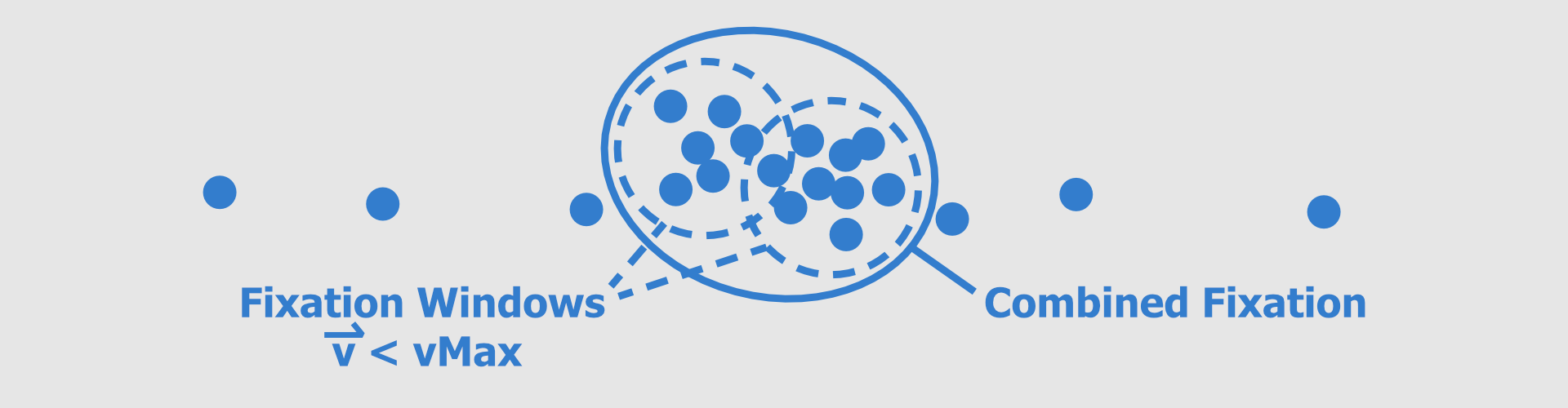
Fixation classification filter based on the Tobii Velocity-Threshold Identification (I-VT) algorithm. The filter classifies eye movements based on the velocity of the directional shifts of the eye. If it is below a certain threshold the sample for which the velocity is calculated is classified as a part of a fixation. There is, in this filter, no distinction between fixations and smooth pursuit. Depending on the set velocity threshold, smooth pursuits are either classified as none-fixations or fixations.
The Tobii I-VT filter is suited for situations where eye tracking quality is good, and your primary concern is detecting periods in which the eye does not move.
The function takes a configuration for the filter, and three arrays of matching timestamps, gaze, velocities and output. All arrays are required to be the same size. This filter must not be used on data with non-monotonic time stamps. The result is written into the output array.
Notes
- This filter must be used on data with monotonic time stamps.
Recommended Configuration
- “detect fixation if angle speed below” - 30.0 deg/s
- “discard fixations below” - 100000 µs
- “gap fill in interpolation duration below” - 75000 µs
- “merge adjacent when angle below” - 3.0°
- “merge adjacent when gap below” - 100000 µs
Output
References
Olsen, Anneli. The Tobii I-VT fixation filter. Tobii Technology (2012): 1-21.